Nobody Was Allowed to Get Comfortable
The Yankees and White Sox each finished with six hits. That is the kind of statistical symmetry that makes a baseball game feel less like a contest of superiority and more like a hearing on who can survive the final paragraph.
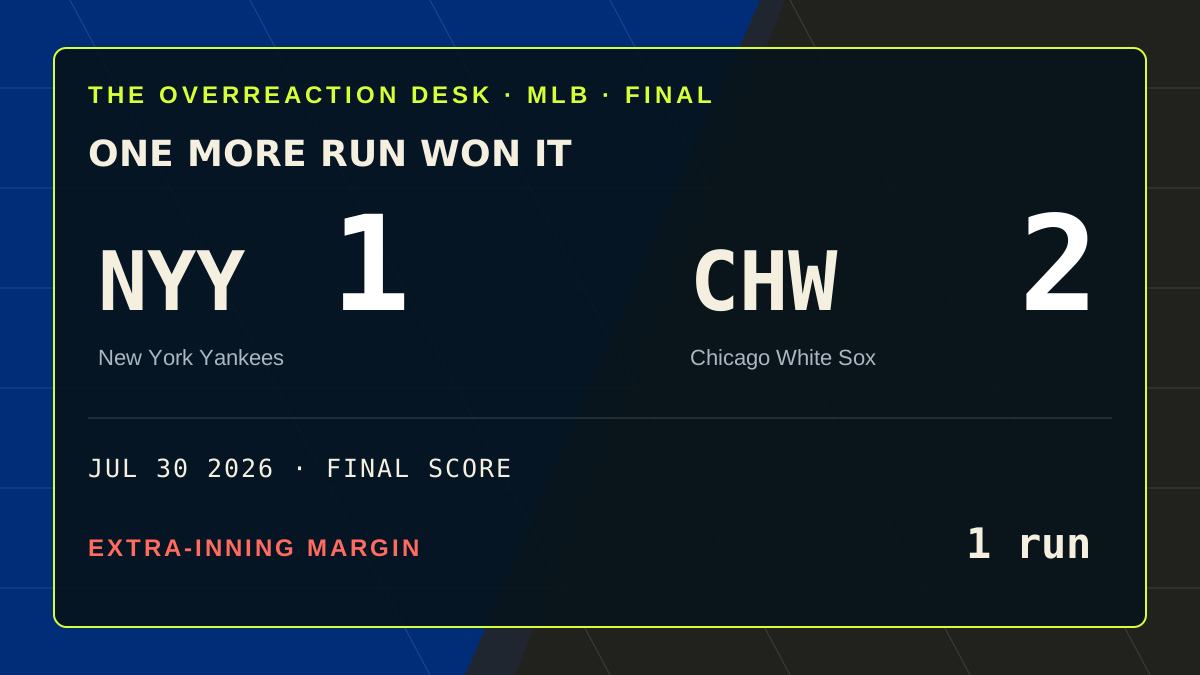
New York scored first when Trent Grisham singled home Anthony Volpe. Chicago answered through Andrew Benintendi, who singled home Tristan Peters. Then the game stopped offering ordinary solutions.
The 1-1 tie held through nine innings, then ten. Every stranded runner made the next one feel more important. Every strikeout looked less like a normal out and more like a missed opportunity that had just become impossible to recover.
The Hit Count Refused to Explain the Result
Grisham went 2-for-4 and supplied New York’s RBI. Randal Grichuk went 2-for-2 for Chicago. The White Sox had six walks to New York’s four, while New York struck out 12 times and Chicago struck out 11.
Chicago also committed an error. None of those details made the White Sox the obvious winner. They made the game a test of which team could keep manufacturing a usable next step after the more glamorous paths had disappeared.
That is the point of the Desk’s extra-inning margin: one run. Chicago did not create a broad advantage. It found the smallest possible one after 11 innings of refusing to let the game end on someone else’s terms.
The 11th Inning Finally Had a Door
The White Sox loaded the bases in the bottom of the 11th. Tristan Peters drew a walk, and Chase Meidroth scored with the winning run. No grand slam arrived to settle the matter. No three-hit rally restored the order. Chicago took the free base it needed and let the extra-inning situation do the rest.
That finish is less dramatic than a towering home run and more revealing. After both lineups had spent ten innings trading scarcity, the White Sox accepted the pressure of waiting for the mistake or the opening. Peters’ walk was the final usable opportunity, and Chicago did not waste it.
For New York, the loss is the unpleasant version of a close-game lesson: matching the opponent’s hit total is not the same as matching its ability to keep an inning alive. For Chicago, the win is proof that a team can survive an imperfect night if it keeps the last door unlocked.
The Desk Has Ruled
Chicago won because it kept playing the game that existed instead of the game it wanted. The White Sox did not hit their way to a statement. They waited through 11 innings, accepted the ugly parts, and took the one run that was available.
The Yankees can point to equal hits and a strong chance to finish the job. Chicago can point to the only score that mattered after midnight. When a game is this small, one more run is not a margin. It is the entire business model.