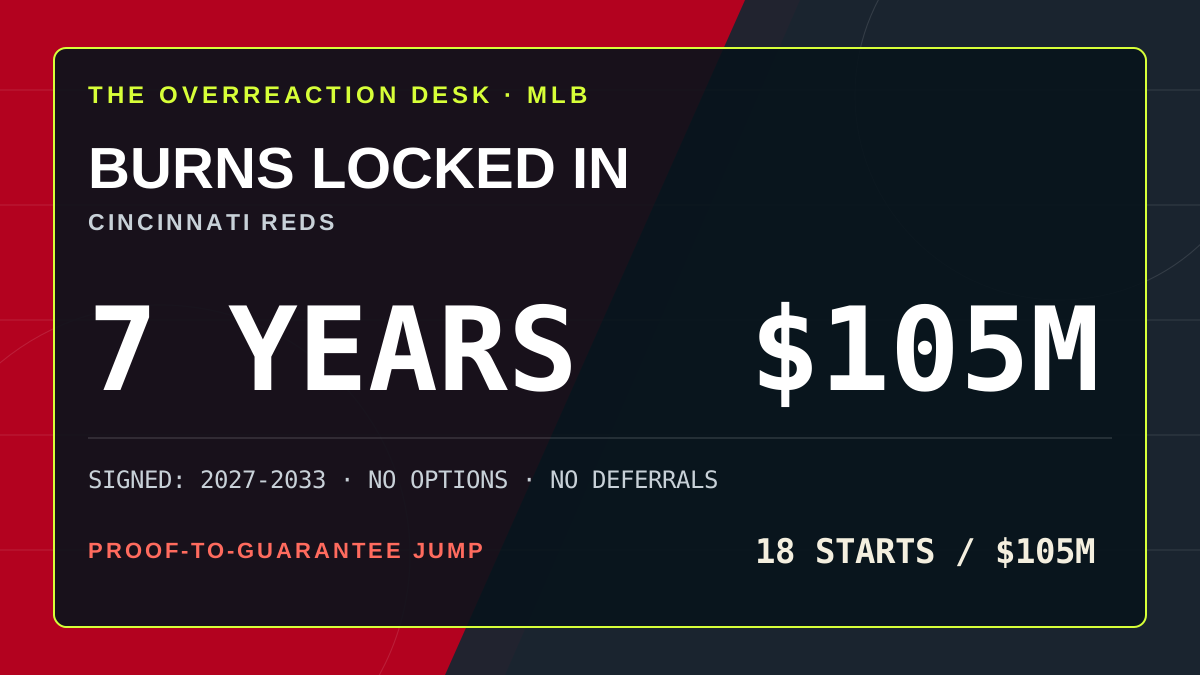
Update, July 18 at 10:19 p.m. ET: Cincinnati has now formally announced that Chase Burns signed the seven-year, $105 million contract. The article and graphic now reflect the official signing.
Correction, July 18 at 7:30 p.m. ET: An earlier version said Cincinnati formally announced this contract. The Reds had not formally announced it as of this recheck; MLB.com and the Associated Press reported the agreement.
The Report Became a Franchise Bet
The Cincinnati Reds formally announced that Chase Burns signed a seven-year, $105 million contract. The deal begins in 2027, runs through 2033 and contains no options or deferrals.
That final detail matters because the terms are not a string of club options dressed up as a long-term promise. Cincinnati guaranteed the full bet after Burns made 18 starts this season. The 23-year-old right-hander is 11-1 with a 2.54 ERA over 102 2/3 innings, earned his first All-Star selection and has allowed two runs or fewer in 15 of those outings.
Burns did not pitch in the All-Star Game after experiencing tightness in his right groin during his July 8 start. MLB.com reported that he was not expected to miss his next scheduled start Tuesday against Seattle. The completed extension did not change that outlook.
Cincinnati Is Buying the Curve
The $105 million extension is not a declaration that 18 starts complete an evaluation. It reflects the belief that the next stages of Burns’ career could make waiting much more expensive.
The extension covers three arbitration-eligible seasons and the first two years after Burns otherwise could have reached free agency, according to the Associated Press. Cincinnati receives cost certainty through his age-30 season while Burns receives life-changing security before pitchers’ ordinary health and performance risks have time to make their argument.
That is the trade. If Burns remains the starter who stormed from the No. 2 pick in the 2024 Draft to the 2026 All-Star roster, the Reds would control two valuable free-agent seasons without an open-market bidding war. If the early dominance proves to be the brightest part of the story, there are no option years waiting to soften the landing.
The Desk Metric: 18 Starts to $105 Million
The Desk’s Proof-to-Guarantee Jump is 18 starts to $105 million: the size of Burns’ 2026 major-league sample against the guarantee Cincinnati attached to it.
This is not a warning that the Reds should have waited for some imaginary perfect sample. Pitchers do not become cheaper after stacking ace-level seasons, and small-market clubs rarely win by waiting until every other buyer agrees with them. The metric shows how aggressively Cincinnati chose to act on the evidence already available.
The guarantee is tied for the largest given to a pitcher in franchise history and tied for the third largest Reds contract overall. That puts Burns beside Homer Bailey in total guaranteed dollars, but Cincinnati is making this commitment at the front of Burns’ prime instead of purchasing a veteran’s established resume.
What Burns Has to Prove Next
The contract does not require Burns to win the National League Cy Young Award this season. It does require the traits behind his first-half results to survive league adjustments, heavier workloads and the unkind calendar of starting pitching.
His first task is the least theatrical one: return from the groin tightness without rushing and resume taking the ball every fifth day. From there, Cincinnati needs the strikeout power, run prevention and availability to become a rotation foundation rather than an excellent half-season exhibit.
The Reds also have to support the investment. Securing a young ace through 2033 is valuable only if the roster around him turns those controlled seasons into real October chances. A bargain contract cannot pitch both ends of a doubleheader or fix every quiet inning by itself.
The Desk Has Ruled
Cincinnati accepted the risk that comes with believing early because disbelief would have carried a price, too. Another year of this production could have moved Burns from expensive to untouchable.
Desk ruling: the Reds did not buy certainty. They bought the right to keep their best pitching outcome from becoming someone else’s free-agent celebration, and they paid before the rest of the league could send an invoice.